ClientEngine AI
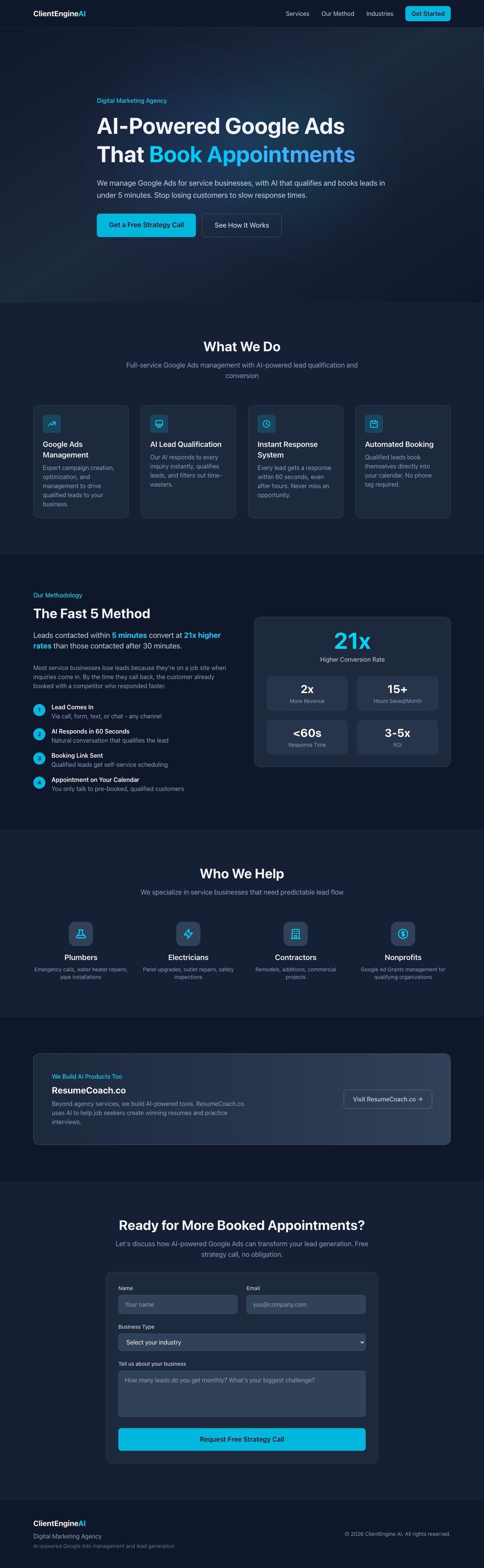
Service businesses are great at the work and terrible at the follow-up. Leads come in while the owner is on a job site. Two hours later, the competitor who responded in five minutes already has the booking.
The Problem
Research consistently shows that leads contacted within 5 minutes convert at roughly 21x the rate of leads contacted after 30 minutes. Service businesses — plumbers, electricians, contractors — routinely wait 2-4 hours to respond. The owner is on a job. The phone goes to voicemail. The lead goes to the next number on Google.
The problem compounds: it's not just response time. Most leads need qualification before they're worth the owner's time. What's the job? What's the location? What's the timeline? A simple auto-responder sends a booking link to everyone — including the people who are price-shopping, out of service area, or asking about work you don't do.
The result is a service business owner who spends time on calls that don't convert and misses calls that would. The follow-up gap isn't a people problem — the owner is already working at capacity. It's a systems problem: no infrastructure to respond, qualify, and route incoming leads without human intervention.
The Approach
The architecture separates lead handling from owner involvement until the lead is qualified:
Instant Multi-Channel Response
An n8n workflow monitors all inbound channels — SMS, web form, chat widget, Google Business profile. When a lead comes in on any channel, a Claude-powered agent responds within 60 seconds. Not a canned auto-reply — a conversational response that begins qualification.
Conversational Qualification
The AI agent qualifies through natural conversation: job type, location, timeline, scope. Qualified leads get a self-service booking link. Unqualified leads get a polite explanation. The owner's calendar only receives appointments the business can actually fulfill — pre-screened, pre-booked.
Nurture Sequences for Not-Yet-Ready Leads
Leads who aren't ready to book enter an automated nurture sequence — follow-up messages timed to re-engage when the timing is better. This recovers leads that would otherwise be lost to inaction. The sequence is Claude-powered: context-aware follow-ups, not broadcast emails.
The Staffing Leverage Model
A 3-person service business with ClientEngine AI handles lead volume that would otherwise require a dedicated receptionist, a sales coordinator, and consistent follow-up processes — functions small businesses typically can't afford. The system runs 24/7 without a team to staff it.
Key Architectural Decision
The initial design used GoHighLevel (GHL) as the central orchestration layer — CRM, pipeline management, email, SMS, and booking in one platform. GHL is powerful and widely used in the agency space. It's also a black box for anything complex: custom qualification logic, multi-model AI routing, and conversation memory that persists across channels don't fit cleanly into a no-code CRM workflow.
The decision: n8n as the orchestration layer with Claude handling qualification, GHL-compatible patterns for CRM and booking. n8n runs locally (avoiding cloud datacenter IP blocking issues already learned from the Slack analytics project), gives full visibility into every workflow step, and integrates with Claude's API without the abstraction layers that would make the qualification logic opaque.
The first deployment is the Masumi Hayashi Foundation — an arts nonprofit handling donor inquiries, event RSVPs, and museum partnership requests. Lower stakes than a plumbing business, higher visibility. The qualification patterns that work for MHF translate directly to service businesses: identify the intent, route appropriately, follow up with context.
Results
The product is in early deployment. The Masumi Hayashi Foundation is the initial customer, pending Google Ad Grant approval. The trades market (plumbing, electrical, HVAC) is the intended scale target — businesses where lead response time directly determines revenue and where the owner is structurally unavailable during business hours.
Technologies
Deep Dives
Early access available for service businesses and nonprofits.
Visit clientengineai.com →