The Work You Do Alone
I built a multi-agent orchestration system that 10x'd my execution speed. Then I discovered the bottleneck that was always there.
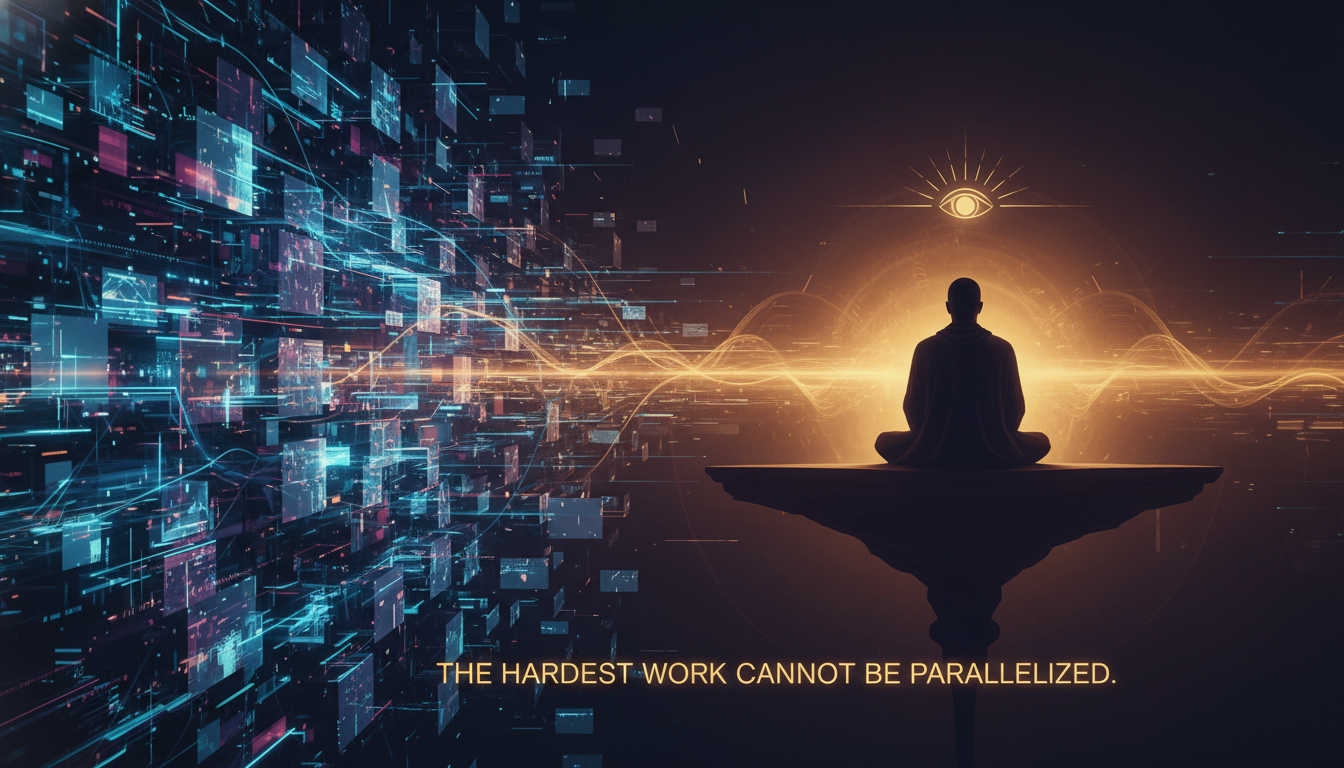
The Work You Do Alone
I built a parallel execution engine for AI work. An orchestrator managing specialist agents—WordPress dev, email processing, security audit, knowledge extraction, workspace curation. Complex workflows that took hours now complete in minutes through coordinated parallel execution.
Morning automation: email scan → task extraction → calendar sync → git commits → workspace cleanup. All simultaneous. All coordinated through SQLite and tmux.
I was operating at 5x baseline. Maybe 10x on the right problems.
Then I hit the wall. Not technical—the system worked beautifully. The bottleneck was me.
Two Kinds of Work
There are problems the parallel engine devours:
- Deploy analytics across 6 portfolio sites
- Audit security configs for all client projects
- Research Next.js 15 migration paths
- Process 47 overnight emails into task database
Execution problems. Clear objectives. Repeatable processes. Parallelizable work.
Then there are problems that make the engine idle:
- Should this client site focus on therapy practice or wellness content?
- Which of these three architectural approaches serves the actual need?
- Is this feature request what they want or what they think they need?
- Does this direction align with where I’m trying to go?
Exploration problems. Ambiguous objectives. Judgment-heavy. Single-threaded by nature.
The parallel engine can’t help. Not because it lacks intelligence. Because clarity can’t be delegated.
The Hidden Shift
Before AI, maybe 80% of my time was implementation: writing code, debugging configs, deploying infrastructure, fighting CSS, hunting dependency conflicts.
Exploration was there—hidden in the noise. “What should this page communicate?” buried between Stack Overflow tabs. Strategic thinking squeezed into 20 minutes before deployment.
AI compressed implementation to near-zero.
What’s left is the work that was always there. The part that can’t be automated. The part only I can do.
Except now it’s not 20% of my time. It’s most of my time.
And I have no parallel engine for it.
The Real Constraint
I can spawn five agents to research competitive positioning. They’ll return comprehensive analyses in 15 minutes. Market data. SEO insights. Content gaps. Competitor tactics.
Perfect execution.
The question remains: What does this client actually need?
That doesn’t get answered by better research. It gets answered by understanding what matters to them. What they value. What trade-offs they’re willing to make. What “success” means in their context.
The bottleneck isn’t intelligence. It’s alignment. Knowing what you actually want.
Your values. Your judgment. Your sense of what’s worth doing.
AI can optimize for any objective. It can’t tell you which objective is yours.
What the System Revealed
The most valuable skill is the one you’re missing.
When I couldn’t code fast enough, coding skill was the bottleneck. AI removed that constraint.
Which revealed the actual constraint: knowing what to code.
Strategic judgment. Domain expertise. Understanding what matters and why. The ability to say “this is the right direction” when the data doesn’t clearly point anywhere.
AI can play every role now. Developer, designer, analyst, writer, tester, deployer.
The one role it can’t play is mine.
The Pattern
After months running the parallel system, the framework emerged:
Execution work scales horizontally. Exploration work doesn’t.
Execution:
- Clear success criteria
- Repeatable processes
- Parallelizable operations
- Optimizable through better tools
- Scales with intelligence applied
Exploration:
- Ambiguous success criteria
- Novel contexts requiring judgment
- Single-threaded by nature
- Improves through clarity, not computation
- Scales with self-knowledge
The sophisticated AI system handles execution brilliantly. It’s the wrong tool for exploration—not because it’s not smart enough, but because exploration requires what AI doesn’t have: your alignment.
The Inflection Point
I still use the orchestration system daily. It’s extraordinarily effective.
But I’ve learned to recognize the signal:
When I’m tempted to spawn parallel research agents to “figure out” a strategic decision—the work is mine. The agents can’t help.
The answer isn’t more intelligence. It’s more clarity.
Which means:
- Sitting with the ambiguity
- Letting competing perspectives exist simultaneously
- Resisting premature resolution
- Trusting the judgment that emerges from my specific context
This doesn’t parallelize. It doesn’t scale. It doesn’t optimize.
The Maxim
The parallel engine multiplies execution. Exploration stays single-threaded.
AI compresses the 80% that was implementation. It can’t compress the 20% that requires your judgment.
That 20% is now most of your time.
The question isn’t “how do I optimize this work?”
The question is “do I know how to do this work?”
If you don’t—if you’ve spent your career optimizing execution—you’re about to discover your actual constraint.
Not intelligence. Not tools. Not time.
Alignment. Knowing what you want. Trusting your judgment. Sitting with ambiguity until clarity emerges.
The work you do alone.
What This Means
Build the parallel engine. Use it. It’s genuinely transformative for execution work.
But recognize what it reveals:
When the engine idles, when the agents have nothing to do, when you’re staring at the screen trying to figure out what to ask—that’s not a failure of the system.
That’s the actual work. The work that only you can do. The work that requires your specific judgment, values, and understanding.
The work that doesn’t parallelize.
The work you do alone.
And if you can’t do it—if the AI just sits there waiting for direction you can’t provide—you’ve discovered something valuable: the skill you actually need to develop.
Not prompt engineering. Not tool mastery. Not AI orchestration.
Strategic judgment. The ability to know what matters. To hold ambiguity without collapsing it prematurely. To trust the direction that emerges from your specific context and values.
This is the skill AI can’t replace. The skill it reveals as essential.
The skill you might have been avoiding by staying busy with execution.
Now the execution is handled. The avoidance ends.
The work begins.
Written by Dean Keesey